| If you have trouble viewing this email, click here to view it in your browser. |
|
|
|
 |
|
Shaping Tomorrow's Built Environment Today
|
|
|
|
ASME Considering Scope Change to Boiler and Pressure Vessel Code
The American Society of Mechanical Engineers (ASME) is considering a scope change to its Boiler and Pressure Vessel Code (BPVC) Section VIII, Rules for Construction of Pressure Vessels, Division I that would eliminate long-standing exemptions for certain equipment manufactured by the Air-Conditioning, Heating, and Refrigeration Institute’s (AHRI) member companies. According to AHRI, the change, if implemented, removes key exemptions that the HVAC&R and water heating industry has successfully covered with its own codes and standards for decades. It would alter the way relevant standards and codes interact with, and are interpreted by, jurisdictions. Removing ASME’s BPVC scope exemptions would place the BPVC in conflict with many codes and standards that currently occupy this space, such as those from nationally recognized testing laboratories (e.g., UL), standards development organizations SDOs (e.g., ASHRAE) and even other ASME codes. Read more in this whitepaper.
|
|
|
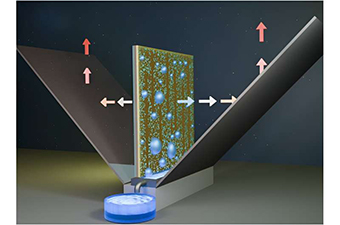
An international research team at King Abdullah University of Science and Technology (KAUST) in Saudi Arabia has designed a solar cooling device that needs no electricity, as it extracts water from the air using nothing more than gravity and relies on cheap, readily available materials. Solar energy currently makes up more than 80% of the country's green energy capacity, leaving these power sources vulnerable to overheating. The device is intended to keep solar cells and other semiconductor technologies cool, while allowing the water to be repurposed for irrigation, washing, cooling buildings on which the solar cells are placed, among other applications. Read more
|
| |
|
Europe's most populated cities are under pressure from the complexities of climate change and rapid urbanization. The EU-funded project, Copernicus for Urban Resilience in Europe (CURE), leveraged the power of Earth Observation satellites to address these issues, aiming to create safer, more sustainable cities for EU citizens. CURE's efforts aimed to fix this problem by taking advantage of the vast amount of information collected by Copernicus, the Earth Observation component of the EU Space Program. Read more
|
|
|
Detroit is home to 19 square miles of vacant land, and utility DTE Energy wants to build large-scale solar arrays on parts of it. Some residents and local officials say it’ll help combat dumping and other nuisance crimes, while also helping the city meet its climate goals. But other neighbors worry using the green space for solar will take away land from potential affordable housing projects and say that putting panels on top of other buildings or outside the city would make more sense. Read more
|
|
| |
|
 |
|
Join ASHRAE Journal Editor Drew Champlin and Kelley Cramm, P.E., Life Member ASHRAE, as they discuss how HVAC factors into code requirements for elevators, the shift to machine room-less elevators and architectural coordination.
|
|
 |
Kelley Cramm, P.E., Life Member ASHRAE
|
|
|
|
|
|
|
|
|
|
|
|
|
|
|
|
|
|
|
|
|
By Ibrahim M. Hasan; Mohamed Yehia, Member ASHRAE; Gamal El-Hariry; Omar Huzayyin, Member ASHRAE
The study presented in this article discusses energy saving and thermal conditions in a dry climate for a simulated building located at Aswan, Egypt. Download here
|
|
|
ASHRAE is accepting abstract submissions for the 2025 Annual Conference to be held in Phoenix, Arizona, June 21-25, 2025, at the Sheraton Phoenix Downtown. Conference papers are requested for the following tracks: “Industrial Ventilation, Refrigeration, Air-Conditioning and Energy Utilization," "Heat Pumps, Refrigerants and Decarbonization," "Onsite Energy Storage," "Workforce Development," "Research Summit," "Fundamentals and Applications" and "HVAC&R Systems and Equipment." Abstracts (400 words or less) are due November 20, 2024. All accepted papers will be considered for publication in Science and Technology for the Built Environment, ASHRAE’s research journal. Read more
|
|
|
|
|
|
|
|
|
|
|
On Sept. 23, the U.S. Environmental Protection Agency (EPA) announced a final rule to establish the Emissions Reduction and Reclamation (ER&R) program to better manage, recycle and reuse climate-damaging hydrofluorocarbons (HFCs) under the American Innovation and Manufacturing (AIM) Act. The final rule includes provisions that will reduce wasteful leaks from large refrigeration and air-conditioning equipment and will support American leadership and innovation in the development of clean solutions to tackle these heat-trapping emissions. Read more
|
|
Feedback
|
Ideas for future ASHRAE HVAC&R Industry News content are welcome. Email us.
|
|
|
|
|
|
|
|
|