Because of their scale, soccer stadiums require a fair amount of energy and water. A single match activates all their systems at the same time: field irrigation, toilets, lighting, ventilation, and services for tens of thousands of people. Ahead of the 2026 World Cup, the first to be held in three countries in 16 different stadiums, FIFA maintained the requirement that the venues must have LEED environmental certifications. For a stadium like Azteca in Mexico City, which opened in 1966, this involved major transformations costing tens of millions of dollars. Read more
|
|
|
|
|
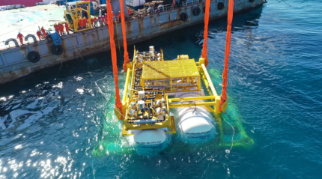
China has become the first country in the world to operate an underwater data center, or UDC, powered by wind. Located off the coast of Shanghai, the complex represents a significant advance in the country's strategy to secure energy supplies in the face of the accelerated growth of artificial intelligence, reduce dependence on fossil fuels, and reduce the environmental impact of its technology infrastructure. Read more
|
| |
|
|
|
Researchers from the Korea Advanced Institute of Science and Technology developed a highly efficient liquid-cooling technology that directly cools high-heat-flux semiconductor chips using room-temperature water. The researchers achieved this by embedding liquid-cooling channels, thinner than a human hair, directly inside a silicon semiconductor chip. The team successfully maintained the chip temperature below 212°F (100°C) even under extreme heat-generation conditions exceeding 2,000 watts per square centimeter. Read more
|
|
|
|
|
The U.S. has generated more power from solar compared to coal for the first time, according to a report by Ember, a think tank focused on the energy transition. In May 2026, solar supplied 12.8% of U.S. electricity, while coal supplied 12.2%, according to an analysis of official monthly and preliminary hourly generation data. A record 45.5 terawatt-hours of solar energy was generated in May 2026, exceeding the output from May 2025 by 17%. The record could be broken again in the upcoming months, as solar output typically peaks in June and July. Read more
|
|
|
|
|
Join host Rebecca Norris along with guests Asit Kumar Mishra and Robert Bean as they explore why there are more myths associated with thermal comfort than other areas of HVAC&R.
|
|
|
|
|
|
|
|
|
|
|
|
|
|
|
|
|
|
|
|
|
|
By Joe Lstiburek
Columnist Joe Lstiburek discusses how various cultures have used water-sensitive building materials while curtailing the possibility of water damage and facilitating the drying process. Download here
|
|
|
ASHRAE, in collaboration with Pacific Northwest National Laboratory (PNNL) and the National Electrical Manufacturers Association (NEMA), announced the release of a comprehensive AI Data Center Energy Performance Framework. The Framework is hosted on ASHRAE’s website, providing industry-wide access to practical, expert-driven guidance for next-generation data center design and operation. Read more |
|
|
The United States is temporarily adjusting Section 232 tariffs on steel, aluminum and copper imports, namely reducing the rate charged for certain industrial and other goods, according to a proclamation signed by President Donald Trump. Having started June 8, a 15% tariff rate now applies to certain HVAC systems and components, the proclamation says. Agricultural equipment such as combines and harvesters also face a 15% tariff, down from a 25% rate Trump set for a slew of derivative steel and aluminum products in April. Read more
|
|
Feedback
|
Ideas for future ASHRAE HVAC&R Industry News content are welcome. Email us.
|