Big Tech’s race to dominate artificial intelligence may soon hit a nasty road bump as U.S. electricity grids struggle to keep pace with the big-spending hyperscalers. America’s technology giants, including Microsoft, Amazon, Alphabet and Meta, have in recent months announced plans to spend over $600 billion on AI in 2026 alone. The investment wave has already fueled unease among some investors about this strategy's profitability. Read more
|
|
|
|
|
|
|
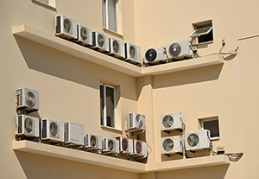
As global temperatures rise, the very thing we turn to to keep ourselves cool could be a significant contributor to increased emissions and an even warmer planet. A new study estimates that by 2050, air-conditioning use is expected to more than double amid rising temperatures, contributing significantly to expected greenhouse gas emissions. What’s more, as incomes rise in developing countries and more low and medium-income regions achieve the same access to AC as high-income regions, we could see an additional 0.015°C to 0.05°C (0.027°F to 0.09°F) of warming by 2050. Read more
|
| |
|
|
|
Some solid materials can cool down or heat up when pressure is applied or released, enabling cooling and heating technologies that do not rely on refrigerant gases. However, a major obstacle remains: many materials behave differently during heating and cooling, which makes their response difficult to use reliably in real devices. In a new study, researchers from the Institut Laue–Langevin investigated a solid material known for its large thermal response under pressure and asked a simple question: can this response be made more reliable? Read more
|
|
|
|
|
The U.S. Department of Energy recently announced that it has offered a $26.54 billion loan to subsidiaries of Southern Company to increase power grid reliability, the largest ever such financing by its loan office. The financing will save power customers in Georgia and Alabama more than $7 billion, the department said, as electricity bills rise on demand from the boom in AI data centers, cryptocurrencies and electrification of transportation. Read more
|
|
|
|
|
|
|
Join ASHRAE Journal technical editor Rebecca Norris and David Schurk as they discuss the importance of effective and efficient filtration in a building HVAC system.
|
|
|
|
|
|
|
|
|
|
|
|
|
|
|
|
|
|
|
|
|
|
By William M. Healy, Ph.D., Kristen Cetin, Ph.D., P.E., Richard Karg, Chandra Sekhar, Ph.D., Li Song, Ph.D., Jerzy Sowa, Iain Walker, Ph.D., and Pawel Wargocki, Ph.D.
This column explores the impact of the shift to more work from home on ASHRAE members who work from home and indirectly on those whom ASHRAE members serve. Key metrics for performance of the built environment are included. Download here
|
|
|
|
|
ASHRAE and the United Nations Environment Programme (UNEP) have approved a new two-year work plan titled Life Cycle Refrigerant Management, reinforcing their long-standing partnership to advance sustainable refrigerant practices worldwide. The plan was adopted during the 2026 ASHRAE Winter Conference in Las Vegas. Read more
|
|
|
|
|
|
|
|
|
|
|
|
|
|
|
|
|
|
A bipartisan bill introduced in the House seeks to improve the indoor air quality (IAQ) in commercial buildings by giving owners tax credits for assessing the IAQ of their facilities and upgrading their HVAC and air filter systems. Titled the Airborne Act, it offers two incentives: a tax credit worth $1 per square foot for conducting property IAQ assessment and one for meeting either ASHRAE Standard 62.1 or ASHRAE Standard 241. Read more
|
|
Feedback
|
Ideas for future ASHRAE HVAC&R Industry News content are welcome. Email us.
|