If you have trouble viewing this email, click here to view it in your browser.
masthead650_858875.jpg
Shaping Tomorrow's Global Built Environment Today
February 5, 2026
New York is beginning to formalize something the building industry has largely treated as an afterthought. Under NYSDEC Part 494, owners and operators are now required to register certain HVAC and refrigeration equipment with the state, marking a significant expansion in how refrigerants are tracked, reported, and regulated. While the rule has technically been on the books, recent escalation deadlines are pulling a much wider swath of commercial and multifamily buildings into compliance, often without owners fully realizing it. Read more
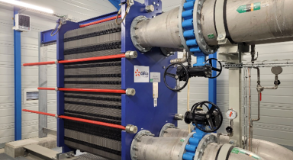
The European Organization for Nuclear Research’s (known as CERN) Large Hadron Collider (LHC), the most powerful particle accelerator on the planet, has provided heating to homes and businesses in the small French town of Ferney-Voltaire for the past few weeks. This was made possible after the Swiss nuclear research organization activated a new heat-exchange system that captures hot water from the cooling circuits of the 16-mile (27-kilometer) accelerator. It then feeds the recovered waste heat directly into the town’s district heating network, supplying the equivalent of several thousand homes and preventing the emissions of thousands of tons of carbon dioxide. Read more
DisguisedVentilation_3216080.png
The U.S. Department of Energy used the Federal Power Act on Jan. 26 to allow data centers within the regional grid operated by PJM Interconnection, including those in Virginia, to use generators at PJM’s discretion through Jan. 31. This was later extended through Feb. 2. The allowance came amid PJM’s record forecasts and demands for electricity and heat during freezing temps. This enabled data centers in Virginia, which has more of the giant server farms than any other state or nation, to run solely on their diesel backup generators in an emergency during cold weather. Read more
In a new study, a team of researchers at Australia's national science agency, CSIRO, University of Queensland, and the Okinawa Institute of Science and Technology (OIST), has theoretically shown how tiny quantum batteries could power a quantum computer—increasing its number of quantum bits (known as qubits) fourfold. Dr. James Quach, co-author of the study and CSIRO's quantum batteries research lead, explained that the computers use significantly less energy because internal quantum batteries can recycle the energy in the system. Read more
Join ASHRAE Journal technical editor Rebecca Norris and David Schurk as they discuss the importance of effective and efficient filtration in a building HVAC system.
 
HOT_AIR_Design200_×_200_2402941.png
ASHRAE Journal
By Jill Leung, Ethan Poon and Felix Chan
Since its establishment in 2007, ELEMENTS has been a prominent shopping mall located atop Kowloon Station in Hong Kong. With a significant cooling capacity exceeding 7,000 tons (25 MW), ELEMENTS underwent progressive digital transformation featuring artificial intelligence to optimize energy efficiency and indoor comfort. This transformation included data quality assessment and retro-commissioning by the consultant to optimize operations through a digital platform. Download here
 
ASHRAE News
ASHRAE announced a dynamic technical program for the 2026 Women in ASHRAE Leadership Symposium, taking place April 13-14 in Los Angeles, California. Following a sold-out inaugural event in 2024, the symposium returns with an expanded agenda designed to empower women and allies across the HVAC&R and built environment industries. Read more
 
In Case You Missed It
A free air conditioner in every New York City apartment may sound downright utopian—and decidedly off-topic in January—but that’s what is in store for apartment dwellers across the five boroughs. A new law requiring landlords to provide cooling to tenants at their request quietly went into effect this week, but with a long lead time for landlords. Actual enforcement by the city Department of Housing Preservation and Development is four years away, in 2030. Read more
Feedback
Ideas for future ASHRAE HVAC&R Industry News content are welcome.  Email us.