If you have trouble viewing this email, click here to view it in your browser.
masthead650_858875.jpg
Shaping Tomorrow's Global Built Environment Today
January 22, 2026
Researchers from the University of Nebraska at Omaha are trying to harness artificial intelligence to make buildings more efficient without sacrificing the comfort of the occupants inside. By giving AI control over heating, air conditioning, ventilation, window shades and other operations of the building, the project team aims to improve the performance of commercial buildings and thereby reduce carbon emissions. Read more
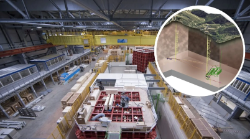
Researchers are making efforts to tackle the colossal engineering feat of building massive, super-cooled containers to hold liquid argon for a flagship physics experiment. The challenge is to contain over 15,000 tons of liquid argon that must be kept at minus 303°F. The effort is part of the Deep Underground Neutrino Experiment, an experiment to learn about neutrinos, the first particles emitted by the Big Bang, which will use detectors that will be immersed in huge baths of cryogenic liquid argon. Read more
DUNE_3219583.png
University of Birmingham scientists have developed a new way of measuring and analyzing indoor air pollution that—in initial trials—has established a clear link between office occupancy, physical activity and air quality. Using radar-powered movement detectors and low-cost pollution sensors, researchers equipped office space in central Birmingham to monitor the number of people present and measure the kinetic energy they generated as they went about their work. Read more
NASA, along with the U.S. Department of Energy (DOE), recently announced a renewed commitment to their longstanding partnership to support the research and development of a fission surface power system for use on the Moon under the Artemis campaign and future NASA missions to Mars. A recently signed memorandum of understanding between the agencies solidifies and advances this collaboration by deploying nuclear reactors on the Moon and in orbit, including the development of a lunar surface reactor by 2030. Read more
Join ASHRAE Journal technical editor Rebecca Norris and Andy Pearson as they discuss the centenary of domestic refrigeration, exploring its historical challenges and innovations that continue to impact modern technology.

HOT_AIR_Design200_×_200_2402941.png
ASHRAE Journal
By Brian Clark
For decades, building automation systems have offered graphical user interfaces intended to help facility management understand and interact with their buildings. By applying what has been learned from the fields of information science and usability engineering, we can get much more from our building graphics, which are windows into system performance. This column provides guidance on what makes a good building graphic and tips to improve them. Download here
 
ASHRAE News
ASHRAE announced a dynamic technical program for the 2026 Women in ASHRAE Leadership Symposium, taking place April 13-14 in Los Angeles, California. Following a sold-out inaugural event in 2024, the symposium returns with an expanded agenda designed to empower women and allies across the HVAC&R and built environment industries. Read more
Products
In Case You Missed It
The U.S. Department of Energy has allocated $2.7 billion to developing a supply chain for nuclear reactor fuel. The department announced contracts for three reactor fuel companies in an effort to undercut Russia’s dominance in the market for advanced reactor fuel. The funding comes as electricity demand increases and federal policy shifts away from renewable energy development. Read more
Feedback
Ideas for future ASHRAE HVAC&R Industry News content are welcome.  Email us.