If you have trouble viewing this email, click here to view it in your browser.
masthead650_858875.jpg
Shaping Tomorrow's Built Environment Today
February 6, 2025
The Boston Zoning Commission has approved an amendment to the city’s zoning code that requires most large new buildings to have net-zero carbon emissions from the day they open. The amendment sets a net zero emissions standard for new project filings after July 1, 2025, that contain 15 units or more, are a minimum of 20,000 ft2 (1,858 m2) in size, or add 50,000 ft2 (4,645 m2)  or more to the size of existing buildings. Read more
Data centers consume vast amounts of energy—about 40% of it for cooling microprocessors alone. Novel cooling methods using ionic wind could drastically curb data center energy consumption. These are based on electrostatic fields to convert electrical current directly and efficiently into an airflow. The low speeds of the generated airflow have so far prevented widespread use, until a new airflow amplifier made it possible to apply ionic wind cooling on a broader scale.  Read more
Ionic_Wind1_3004084.jpg
Increased use of ventilation and air cleaners, designed to mitigate the spread of viral infections in hospitals, is likely to have unpredictable effects and may cause viral particles to move around more, according to researchers at the University College London and University College London Hospitals NHS Foundation Trust. The study, published in Aerosol Science & Technology, investigated the effect of using built-in mechanical ventilation and portable air cleaners upon the spread of airborne particles, which are similar to those breathed out by a person with a viral respiratory infection such as SARS-CoV-2 or influenza. Read more
Several of the executive orders issued by President Donald Trump in the first two weeks of his second term have impacted the clean energy industry, including: a six-month pause on offshore wind development in federal waters, a pause on certain Inflation Reduction Act and Bipartisan Infrastructure Law funding and a freeze on federal grants and loans. Some clean energy developers and advocacy groups are also awaiting further clarification on the scope of the orders, as several pieces of clarifying guidance have already been issued by the Office of Management and Budget. Read more
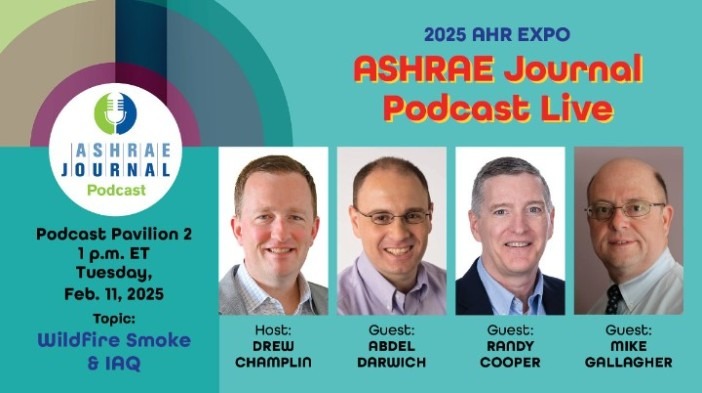
Liquid Cooling in Data Centers ASHRAE Journal Podcast
Join hosts Matt Walters, Associate Member ASHRAE, and Allison Hambrick, ASHRAE Journal Assistant Editor, for a discussion with 2024–25 ASHRAE President Dennis Knight about this term’s ASHRAE Society theme “Empowering Our Workforce: Building a Sustainable Future” and what’s next for the HVAC&R industry.
 
 
ASHRAE Journal Podcast Liquid Cooling in Data Centers
S6E46_Podcast_Social_3002546.jpg
ASHRAE Journal
This article discusses an energy-saving approach to hot-standby sparing (HSP) operation and control of cooling system redundancy equipment, which is crucial for ensuring the operational reliability of data centers. It also presents a design case and quantifies the energy savings for data center cooling achieved using this approach. Download here
ASHRAE News
ASHRAE is offering a new benefit to enhance the value of its online instructor-led courses through the ASHRAE Learning Institute (ALI). Starting with its 2025 online course schedule, ALI is offering a free recommended ASHRAE publication with each online course registration. The goal of the free bonus publication is to reinforce the course material and support deeper understanding of the subject matter. Read more
Products
In Case You Missed It
TerraPower, a nuclear energy startup founded by Bill Gates, struck a deal this week with one of the largest data center developers in the U.S. to deploy advanced nuclear reactors. TerraPower and Sabey Data Centers are working together on a plan to run existing and future facilities on nuclear energy from small reactors. Read more
Feedback
Ideas for future ASHRAE HVAC&R Industry News content are welcome.  Email us.