If you have trouble viewing this email, click here to view it in your browser.
masthead650_858875.jpg
Shaping Tomorrow's Built Environment Today
December 12, 2024
In this feature by WIRED, journalist Lisa Wood Shapiro reports on an air quality cabin experiment she conducted in a Maine cabin this past summer. She tested air purifiers, food dehydrators and indoor air quality monitors, tracking outdoor air quality, monitoring the indoor air and watching the numbers climb in their predictable pattern when she used her stove. A couple weeks into the experiment, Shapiro noticed odd spikes in PM2.5 for seemingly no reason. Read more
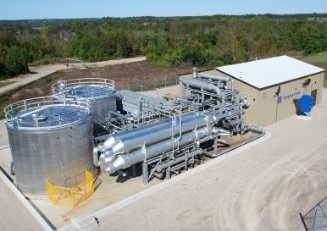
A study from several universities and national labs in the United States and Canada shows that large-scale deployment of long-duration energy storage isn’t just feasible but essential for renewables to reach their full potential. It looked specifically at the Western Interconnection, a chunk of the grid that includes the western U.S. and Canada, plus a bit of northern Mexico. The study found that building more long-duration energy storage there would reduce electricity prices by more than 70% in times of high demand. Read more
Water is pumped in and out of caverns to store energy generated by renewables. Image Credit: Hydrostor
Microsoft revealed details of new approach to cooling data centers that won’t lose water to evaporation.
The strategy will still use water, but it’s contained in a closed-loop system where it flows past heat-generating processing chips, drawing off heat that it carries to chillers. Then the cooled water starts the journey all over again. Microsoft data centers gulped down roughly 33 million gallons of water per center in the last fiscal year, according to company estimates. Read more
ASHRAE Journal Podcast Episode 43 Occupancy in the Built Environment
Join guests Amr Suliman and Marina Topouzi for this episode on occupancy in the built environment. This slice on building occupancy covers ventilation, indoor environmental quality, resilience, harnessing data on occupant behavior and how building efficiency and indoor conditions can be improved for a healthier, optimized built environment.
 
 
Occupancy in the Built Environment: Amr Suliman and Marina Topouzi
ASHRAE Journal
By Steve Kavanaugh, Ph.D.
This article reviews field data from long-term ground source heat pump systems that often diverge from ground heat exchanger model results, and in doing so shows why it’s necessary to obtain much larger field data sets. Download here
ASHRAE News
The EPA's Indoor Environments Division is pleased to announce that the ASHRAE Guideline 44 “Protecting Building Occupants from Smoke During Wildfire and Prescribed Burn Events”, is now available for purchase from the ASHRAE Bookstore. The purpose of the Guideline is to recommend building measures to minimize occupant health impacts from wildfire and prescribed burn smoke events. The focus of the guideline is on commercial, institutional and multi-unit residential buildings. It is the first guideline of its kind to provide recommendations to help building owners and managers prepare for and respond to smoke. Read more
Products
In Case You Missed It
Solar energy, though abundant, faces the challenge of intermittent supply. While battery energy storage is widely used to store solar, a promising alternative—gravity energy storage—has emerged. Gravity energy storage has the potential to be a cornerstone of sustainable energy systems with its capacity for long-term energy storage and low maintenance. The technology involves lifting a heavy mass during excess energy generation and releasing it to produce electricity when demand rises or solar energy is unavailable. Read more
Feedback
Ideas for future ASHRAE HVAC&R Industry News content are welcome.  Email us.