If you have trouble viewing this email, click here to view it in your browser.
masthead650_858875.jpg
Shaping Tomorrow's Built Environment Today
August 1, 2024
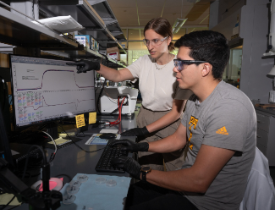
Researchers at Georgia Tech are developing more efficient heating systems that don't rely on fossil fuels. The research was presented in an article titled "Thermochemical energy storage using salt mixtures with improved hydration kinetics and cycling stability," published in the Journal of Energy Storage that showed that combining two commonly found salts could help store clean energy as heat, and had the potential to heat buildings or be integrated with a heat pump to cool buildings. Read more
PhD Students Erik Barbosa and Madeline Morrell analyze water vapor storage and release in salts. Image credit: Allison Carter
This article covers seven lessons learned from the COVID-19 pandemic about ventilation's crucial role in preventing the spread of airborne pathogens set out by several air quality scientists. Their study, "Ventilation and indoor airborne infection transmission: Lessons learned from the COVID-19 pandemic," published in Science, highlights the need to reduce the risk of infection through sufficient and effective ventilation of indoor spaces. Read more
Federal labor officials recouped more than $1.5 million in unpaid overtime wages and damages — an amount said to be “one of the largest recoveries of its kind” — from a Dallas-area company that misclassified workers as independent contractors. By misclassifying their employees, an investigation by the  U.S. Department of Labor found that the company owed 430 technicians more than $756,000 in unpaid overtime wages and an equal amount in liquidated damages. Read more 
The U.S. Department of Energy (DOE) today announced $33 million for nine projects across seven states to advance concentrating solar-thermal (CST) systems technologies for solar fuel production and long-duration energy storage. CST technologies use mirrors to reflect and concentrate sunlight onto a receiver, helping to produce carbon-free clean fuels, heat, and storage for a wide variety of applications. Read more 
Did you know milk dust and flour, among other dusts, are explosive? Combustible dusts require the use of dust collectors. Chris Jester discusses the design of these systems, including air velocity and duct sizing, safety considerations, motor requirements and relevant codes.
 
 
Data Center Energy Compliance Strategies in Hot Climates With Hamed Yassaghi
ASHRAE Journal
By Kishor Khankari, Ph.D., Fellow ASHRAE
The computational fluid dynamics (CFD) study in this article evaluates the impact of air changes per hour (ach) and the locations of supply diffusers on the airflow patterns and the resulting distribution of particles in the critical zone of a pharmaceutical cleanroom, which is used for manufacturing sterile and nonsterile drugs and medical products and often require a high level of cleanliness to maintain an aseptic environment. Download here
ASHRAE News
ASHRAE and the World Filtration Institute (WFI) have signed a Memorandum of Understanding formalizing the organizations’ relationship.  The agreement outlines how ASHRAE and WFI will work cooperatively on common public affairs initiatives and leverage the strengths of both organizations to address critical challenges in the industry, while promoting innovative solutions that benefit the global community. Read more
In Case You Missed It
According to a new study published in Science of the Total Environment, the materials in car cabins can release high levels of semi-volatile organic compounds (SVOCs), a group of potentially endocrine disrupting chemicals, into the surrounding air. The study showed that nine different SVOCs were detected in the air and dust of car interiors and that their concentration increased at higher temperatures, and that turning on the car ventilation system effectively reduced chemical exposure. Read more
Feedback
Ideas for future ASHRAE HVAC&R Industry News content are welcome.  Email us.